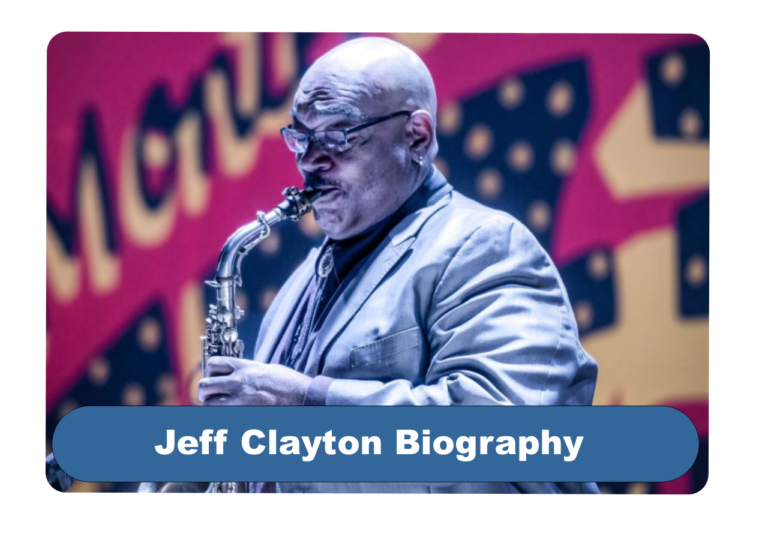
Jeff Clayton biography covering the American jazz saxophonist’s early life, work with Stevie Wonder and Frank Sinatra, Clayton Brothers career, family, teaching, awards and death from kidney cancer.
The Jeff Clayton biography is the story of an American jazz saxophonist, flutist, bandleader and educator whose career connected jazz with some of the biggest names in popular music. Clayton performed and recorded with artists including Stevie Wonder, Frank Sinatra, Ella Fitzgerald, Michael Jackson and Ray Charles, while building his own musical identity through the Clayton Brothers and the Clayton-Hamilton Jazz Orchestra.
His expressive alto saxophone playing made him a respected figure in West Coast jazz, but performing was only part of his contribution. Clayton also devoted decades to teaching younger musicians and sharing the experience he had gained from working with major jazz and pop artists. He died in Los Angeles in December 2020 after battling kidney cancer.
Jeff Clayton Quick Facts
| Detail | Information |
|---|---|
| Full Name | Jeffrey Leland Clayton |
| Known As | Jeff Clayton |
| Born | February 16, 1955 |
| Birthplace | Venice, California, United States |
| Died | December 16, 2020 |
| Age at Death | 65 |
| Nationality | American |
| Occupation | Jazz saxophonist, flutist, bandleader and educator |
| Main Instruments | Alto saxophone, flute and other woodwinds |
| Brother | John Clayton |
| Known For | Clayton Brothers and Clayton-Hamilton Jazz Orchestra |
| Education | Studied at California State University, Northridge |
| Cause of Death | Complications from kidney cancer |
Some music reference sources give Clayton’s birth year as 1954. However, detailed contemporary obituaries published after his death identify him as born on February 16, 1955, and report that he was 65 when he died in December 2020.
Early Life in California
Jeffrey Leland Clayton was born in Venice, California, and grew up in the Los Angeles area in a musical family.
His mother was a church pianist and organist who encouraged music at home. Gospel music formed part of Clayton’s early musical environment, alongside the Motown, soul and rhythm-and-blues records popular during his childhood.
His older brother, John Clayton, also developed into a professional musician and became a highly regarded bassist, arranger and composer.
Jeff began playing clarinet while still young and later added saxophone. By his teenage years, the saxophone was becoming increasingly important to him.
Jazz was not necessarily his first musical obsession. Clayton later became more seriously interested in the genre through his high-school jazz band, where exposure to improvisation and ensemble playing helped redirect his musical ambitions.
The two Clayton brothers would eventually become one of the most recognisable sibling partnerships in modern jazz.
Studying Music at Cal State Northridge
Clayton enrolled at California State University, Northridge, in 1973.
His formal training extended beyond the saxophone. He studied oboe and English horn and completed more than three years of university work.
He never finished the degree.
With roughly one semester remaining, Clayton received an opportunity that was difficult for an aspiring professional musician to reject: he was invited to join Stevie Wonder’s band.
Instead of remaining at university, he went on the road.
That decision effectively marked the beginning of Clayton’s full-time professional career.
Touring With Stevie Wonder
Working with Stevie Wonder exposed Clayton to large audiences and the demands of performing at the highest level of popular music.
He spent about three years recording and touring with Wonder.
The experience had a lasting influence on his musicianship. Clayton later spoke about learning how to make musical ideas concise and effective rather than filling every available space with notes.
After leaving Wonder’s organisation, Clayton returned to Los Angeles and became an in-demand studio and touring musician.
His ability to move comfortably between jazz, soul, pop and rhythm and blues made him useful in an industry where musicians were often expected to adapt quickly to very different artists and recording sessions.
Session Work With Michael Jackson, Madonna and Other Stars
Clayton’s career as a session musician placed him alongside an unusually broad collection of major performers.
His recording credits included work with Gladys Knight, Kenny Rogers, Patti LaBelle, Michael Jackson and Earth, Wind & Fire.
He also recorded with Madonna. His work connected with her music brought him Grammy recognition during his career.
Clayton’s résumé stretched well beyond studio recordings.
He toured or performed with artists including Ray Charles, B.B. King, Lena Horne, Sammy Davis Jr. and Ella Fitzgerald.
These collaborations demonstrate how comfortably he operated between commercial popular music and traditional jazz.
However, Clayton never allowed session work to become his entire musical identity.
His most enduring projects were built around jazz.
Jeff Clayton and Frank Sinatra
One of Clayton’s important professional relationships was with Frank Sinatra.
He worked with Sinatra both in live performances and in studio settings over an extended period.
Clayton later credited the experience with teaching him important lessons about melody and phrasing.
Playing behind a singer such as Sinatra required a different musical approach from taking a long jazz solo. Clayton learned to respect the shape of a melody and the space surrounding a vocalist.
That sensitivity became part of his own playing style.
His career also allowed him to learn directly from other major jazz figures. Clayton often spoke about absorbing different lessons from musicians and bandleaders he encountered rather than treating every engagement simply as another job.
The Clayton Brothers
Jeff and John Clayton formally established the Clayton Brothers in 1977.
The group became one of the central projects of Jeff Clayton’s career.
While John played bass, Jeff became known for his alto saxophone and flute work. The ensemble’s personnel changed over the years, eventually developing into a quintet featuring musicians such as trumpeter Terell Stafford.
John’s son, pianist Gerald Clayton, also became part of the group, adding another generation of the Clayton family to the ensemble.
The Clayton Brothers released a series of recordings across several decades.
Albums associated with the group include The Music, Expressions, Siblingity, Back in the Swing of Things, Brother to Brother, The New Song and Dance and The Gathering.
The ensemble’s recordings received Grammy recognition.
Brother to Brother was nominated for Best Jazz Instrumental Album, while the group’s later work also generated additional Grammy nominations.
More importantly, the Clayton Brothers provided Jeff and John with a setting where they could develop their own compositions, arrangements and interpretation of straight-ahead jazz rather than functioning primarily as sidemen.
Clayton-Hamilton Jazz Orchestra
Jeff Clayton’s other major long-term project was the Clayton-Hamilton Jazz Orchestra.
He formed the big band with his brother John and drummer Jeff Hamilton during the 1980s.
The orchestra developed into one of the important large jazz ensembles associated with Los Angeles.
The band combined original compositions and arrangements with the traditions of swing and big-band jazz. Clayton was both a co-leader and one of its principal soloists.
Its recordings included projects such as Groove Shop, Heart and Soul, Absolutely and Explosive!.
The orchestra also worked with notable guest artists and became closely connected with the Los Angeles jazz community.
In 1999, the Clayton-Hamilton Jazz Orchestra became the resident jazz orchestra associated with the Los Angeles Philharmonic’s jazz programming.
For Clayton, the ensemble represented another side of his musical personality. The Clayton Brothers gave him a smaller-group environment, while the Clayton-Hamilton Jazz Orchestra allowed him to work within the sound and structure of a large ensemble.
Work With the Count Basie Orchestra
Clayton also spent time with the Count Basie Orchestra.
He played with the ensemble during different periods, including after Count Basie’s death when trumpeter and arranger Thad Jones was leading the orchestra.
Clayton later cited Jones as an important influence on how he approached rehearsals and ensemble leadership.
His association with the Basie tradition placed him directly within one of the most important lineages in American big-band jazz.
Rather than simply copying earlier styles, Clayton carried lessons from those musicians into his own bands and educational work.
Jeff Clayton as a Jazz Educator
Teaching became an important part of Clayton’s later career.
He taught students at different levels, from young beginners to university musicians, and regularly participated in jazz workshops, clinics and music camps.
His academic teaching included periods at institutions such as UCLA and the University of Southern California.
He also taught and conducted educational activities at other universities and jazz programmes.
For Clayton, teaching was not separate from performing. He viewed it as a way to pass on the information that older musicians had shared with him.
That approach was particularly valuable because his career had given him experience in several musical worlds. He could discuss touring with pop stars, playing behind vocalists, working in big bands, improvising in small jazz ensembles and surviving as a professional studio musician.
Both Jeff and John Clayton became widely respected for their commitment to jazz education.
Jeff Clayton’s Brother John Clayton
Jeff Clayton’s older brother, John Clayton, is a Grammy-winning bassist, composer, arranger, conductor and educator.
Their careers frequently overlapped, but they were accomplished musicians independently of one another.
John performed with artists including Monty Alexander and Count Basie and developed a substantial career as an arranger and composer.
Together, the brothers created the Clayton Brothers and later joined Jeff Hamilton in building the Clayton-Hamilton Jazz Orchestra.
Their musical relationship lasted for more than four decades.
John’s son Gerald Clayton also became an acclaimed jazz pianist, turning the Clayton family into a multigenerational presence in American jazz.
Following Jeff’s death, John publicly paid tribute to his brother and reflected on the decades of music they had shared.
Wife and Personal Life
Jeff Clayton was married.
His brother John confirmed after Clayton’s death that his wife was with him during his final moments. However, Clayton kept much of his private family life outside the public spotlight.
Reliable mainstream biographical sources provide considerably more information about his musical relationships than about his marriage or children.
For that reason, details frequently repeated on unsourced biography websites should not automatically be treated as established facts.
Clayton’s most publicly documented family relationship remains the musical partnership with his brother John and his work alongside his nephew Gerald Clayton.
Grammy Recognition and Career Achievements
Clayton’s work received several forms of professional recognition.
Recordings by the Clayton Brothers earned Grammy nominations, including Brother to Brother and The New Song and Dance.
His decades of work also placed him on stages and recordings with some of the most influential performers of the twentieth century.
Beyond formal awards, Clayton’s standing among fellow jazz musicians was significant. He was respected as an alto saxophonist with an expressive sound, as a reliable ensemble player and as a musician capable of communicating with both audiences and students.
In 2022, after his death, the California Alliance for Jazz inducted Clayton into its Hall of Fame.
The honour recognised his wider contribution to jazz as a performer, bandleader and educator.
Jeff Clayton Net Worth
Jeff Clayton’s exact net worth was never reliably disclosed.
There is no credible financial record supporting the precise wealth estimates sometimes attached to musicians on celebrity-net-worth websites.
Clayton earned his living across several areas of the music industry. These included touring, recording sessions, album releases, live jazz performances, bandleading and teaching.
He also spent decades performing with established artists and operating within professional jazz ensembles.
However, career longevity and prestigious musical credits are not enough to calculate personal wealth accurately.
Without dependable information about his assets, royalties, investments and liabilities, assigning a specific net-worth figure would be speculation.
The most accurate conclusion is that Clayton maintained a long professional career in music, but his personal net worth was not publicly established.
Jeff Clayton’s Illness and Cause of Death
Jeff Clayton was diagnosed with kidney cancer during the final years of his life.
He battled the disease for approximately two years.
Clayton died at his home in Los Angeles on December 16, 2020. His manager confirmed that the cause of death was complications from kidney cancer.
His wife and brother John were with him when he died.
Contemporary obituary reports gave his age as 65.
News of his death led to tributes from musicians who remembered not only his playing but also his personality, generosity and commitment to teaching.
Legacy
Jeff Clayton spent decades moving between roles that many musicians would consider separate careers.
He toured with Stevie Wonder, worked with Frank Sinatra and Ella Fitzgerald, recorded with pop stars, played in the Count Basie Orchestra and helped lead two enduring jazz ensembles.
At the same time, he remained committed to teaching.
The Clayton Brothers preserved the musical partnership he shared with John, while the Clayton-Hamilton Jazz Orchestra demonstrated his importance to large-ensemble jazz in Los Angeles.
His influence also continued through the musicians he taught and through the work of his brother, nephew and longtime collaborators.
Conclusion
Jeff Clayton built a career that connected generations and styles of American music.
His work with Stevie Wonder opened the door to professional touring, while later sessions brought him into contact with artists ranging from Michael Jackson to Madonna. Jazz nevertheless remained at the centre of his identity through the Clayton Brothers, the Clayton-Hamilton Jazz Orchestra and his work with major figures such as Count Basie, Frank Sinatra and Ella Fitzgerald.
The Jeff Clayton biography is also inseparable from education. He spent years passing on the musical lessons he had learned from some of the industry’s most accomplished performers.
Clayton died from complications of kidney cancer in 2020, but his recordings, bands and contribution to jazz education remain an important part of his legacy.
Frequently Asked Questions
Who was Jeff Clayton?
Jeff Clayton was an American jazz alto saxophonist, flutist, bandleader and educator. He was best known as a co-founder of the Clayton Brothers and Clayton-Hamilton Jazz Orchestra and for performing with artists including Stevie Wonder, Frank Sinatra and Ella Fitzgerald.
When was Jeff Clayton born?
Detailed contemporary obituary accounts give Jeff Clayton’s birth date as February 16, 1955. Some music reference databases list 1954, creating a minor discrepancy in published sources.
Who was Jeff Clayton’s brother?
Jeff Clayton’s older brother was John Clayton, a Grammy-winning jazz bassist, arranger, composer and educator. The brothers performed together for decades in the Clayton Brothers and Clayton-Hamilton Jazz Orchestra.
Did Jeff Clayton play with Stevie Wonder?
Yes. Clayton left California State University, Northridge, before completing his degree after being invited to join Stevie Wonder’s band. He spent about three years recording and touring with Wonder.
Was Jeff Clayton married?
Yes. Reliable reports confirm that Clayton was married and that his wife was with him when he died. He generally kept details of his marriage and private family life away from public attention.
What was Jeff Clayton’s net worth?
Jeff Clayton’s exact net worth was never reliably disclosed. Although he maintained a lengthy professional career in recording, touring, jazz performance and education, there is not enough credible financial information to establish a specific figure.
What happened to Jeff Clayton?
Jeff Clayton died in Los Angeles on December 16, 2020, after battling kidney cancer. His death was attributed to complications from the disease.